
The 3 places execution breaks in a sales process

Revenue, Decoded is Glyphic's weekly read for revenue teams who'd rather fix problems than talk about them.
This week:
→ The three places execution breaks — and why it's always a handoff
→ A small Glyphic fix that keeps your CRM reporting honest
→ How Eimear, AE, cuts no-shows to demos to zero
→ We'll be at Forrester B2B Summit next week — Booth 124 (and more surprises)
Read it below!
The 3 places execution breaks in a sales process
Most GTM teams would think they have a strategy problem. Yet, in reality, they have a handoff problem. The strategy is fine, the playbook is fine.
But somewhere between marketing and sales, between discovery and proposal, between close and onboarding — context gets lost, momentum stalls, and by the time anyone notices, the deal is already drifting.
Here's where it breaks, and what to do about it.
1. Marketing → Sales: the lead arrives cold
The prospect downloaded your whitepaper, attended your webinar, replied to three nurture emails, and signaled pretty clearly what problem they're trying to solve. Then they hit "request a demo" and get handed to an SDR who opens with: "So, what brought you to us today?"
All that context — the campaign, the content they engaged with, the problem they signaled — lives in the MAP and dies there.
It doesn't follow the lead. The rep starts from scratch, asks questions the prospect already answered, and the relationship begins with friction instead of relevance.
This is a "we treat MQL handoff as an admin task instead of a context transfer" problem.
The fix: Build a lead brief that travels. Before a rep touches a new lead, they should see: what content they engaged with, what problem it maps to, and what the prospect has already told you.
If your MAP and CRM don't talk to each other automatically, do it manually with a standard handoff template. The first call should feel like a continuation, not an introduction.
2. Discovery→ Proposal: When it gets too flat
The discovery call was good, and the prospect opened up. They told you about the internal politics, the failed implementation two years ago, the real reason they're looking now, the person whose approval actually matters.
The AE walked away with a clear picture.
Then the proposal goes out and it looks like every other proposal. The specific pain is gone. The internal context is gone. What's left is a deck that could have been sent to any company in their industry.
The prospect feels unseen, the deal slows.
And the AE wonders why there's no urgency on the other side — when the truth is, the proposal never reflected the conversation that created it. All that discovery lived in someone's head or a call recording nobody watched.
But by now, almost every team has a notetaker. The calls are recorded. The summaries exist. The real issue is that those notes are locked to the individual.
They live in Gong or in someone's inbox, invisible to anyone who wasn't on the call. The AE who needs to write the proposal can't easily surface what was said. The context exists — it just doesn't travel.
The fix: Discovery notes need to be structured and accessible, not just stored. Before anyone opens a slide deck, the AE should be able to pull the prospect's specific pain, the key stakeholders, and what success looks like to them — directly from the call.
When that's automated, proposals stop looking generic because they're not built from memory anymore.
3. AEs → CS: The vision doesn't survive the close
The customer was sold on a specific outcome. The AE knew their situation inside out — the champion's personal stake, the timeline pressure, the exact use case they were betting on.
The deal closed. Everyone celebrated. CS inherits a Salesforce record. Closed date. Contract value. Maybe a one-line note that says "strong fit, eager to get started."
Onboarding starts from scratch. The customer has to re-explain everything they already told sales. Trust erodes fast. And expansion — which should feel like a natural next step — becomes a cold conversation because nobody documented what was promised or why they bought.
The fix: The close is not the finish line, it's a handoff. Before a deal is marked closed-won, the AE should complete a transition doc: why they bought, what outcome was promised, who the champion is and what they care about, and any landmines CS needs to know.
It takes 15 minutes and it changes the entire onboarding dynamic.
The customer feels heard. CS starts with context instead of questions. Expansion conversations start earlier.
The common thread: your team isn't necessarily missing information, but it's missing shared access to it.
The notes are there. The calls are recorded. But the knowledge is siloed — locked to the person who was on the call, on the deal it was tagged to, invisible to everyone else who needs it.
That's the problem Glyphic solves.
Not just capturing what happens in calls, but making sure it surfaces to the right person at the right moment — whether that's the SDR prepping for a first call, the AE building a proposal, or CS walking into their first onboarding session.
Context that travels. That's what makes a handoff work.
Check out Adam's session at the Forrester B2B Summit next week!
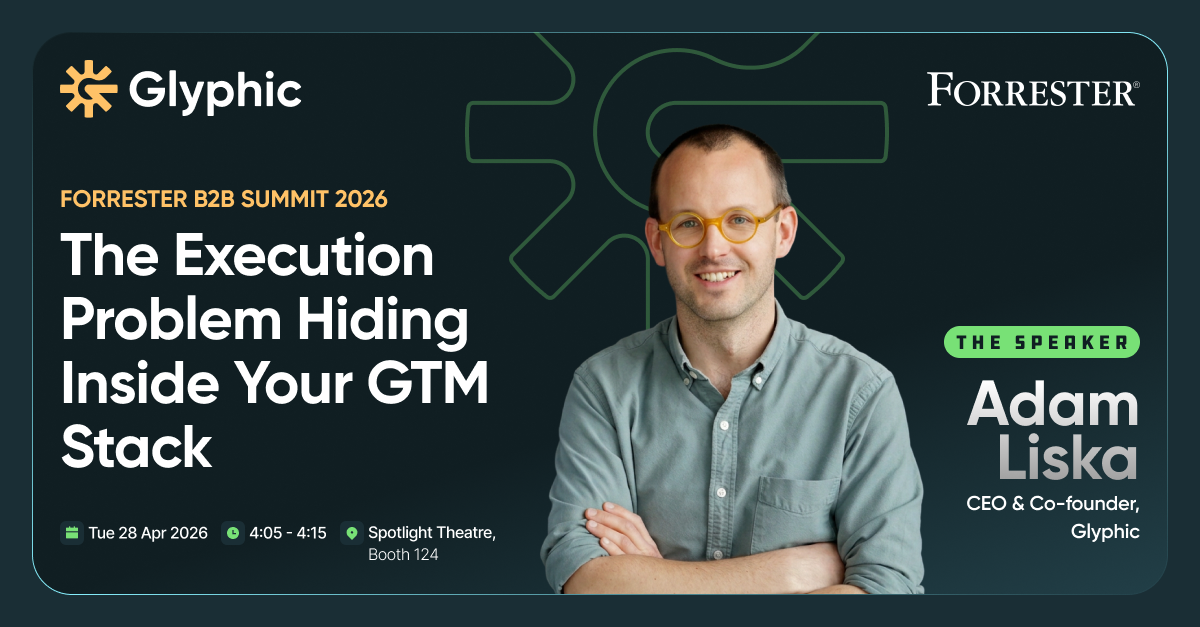
We'll be in Phoenix next week — and Adam's got a session worth catching. If you're at Forrester B2B Summit, come find us at Booth 124. Adam Liska, our CEO, is running a session on Tuesday that picks up exactly where this newsletter leaves off.
"The Execution Problem Hiding Inside Your GTM Stack"
📅 Tue 28 Apr · 4:05–4:15 · Spotlight Theater, Hall E 📍
For more information or to book a meeting with us in Phoenix, please visit here.
See you next week in Phoenix!
How Eimear cuts no-shows BEFORE they happen
.jpeg)
Here's something we don't talk about enough: the meeting is booked, but it never happens.
No-shows are a silent pipeline killer. The SDR hit their number, the AE blocked the time, and then — nothing. No reply, no reschedule, just a ghost. And most teams treat it as bad luck rather than a solvable problem.
Eimear, one of our AEs, ran a session this week with the team on exactly this. Her view: no-shows are almost always a follow-up problem in disguise. The prospect said yes in the moment, but nothing after the booking reinforced why the meeting was worth showing up to.
Her three-step fix:
1. Send the recap the same day the meeting is booked. Not the next morning. That day. Recap what was discussed, confirm what they're going to see, and make it easy to forward internally. The longer you wait, the colder it gets.
2. The day before: send a confirmation with an agenda.
Not "just confirming our call tomorrow."
An actual agenda — what you'll cover, what you need from them, what they'll walk away with. Sync with your AE first so you're aligned on what's being positioned. A prospect who knows what to expect shows up prepared, not skeptical.
3. If the meeting is more than a week out, keep them warm. Drop them into a nurture cadence — not to sell, but to stay relevant. Share something useful. Engage with their LinkedIn.
By the time the meeting comes around, you're not a stranger from a cold email. You're someone they've already been thinking about. Small habits. Big difference to show rate.
Glyphic product updates: call matching now available
Here's something that quietly breaks CRM data and nobody talks about: calls matched to the wrong deal.
Wrong match means wrong insights. Wrong reporting. Wrong everything. It sounds like a small thing — until you're trying to forecast off it and the numbers don't make sense.
We've always had robust matching logic — who's on the call, deal ownership, company domain. But sometimes two deals are nearly identical. Same champions, different products. Same company, different teams. The logic needs a nudge.
So we built one. You can now manually match any call to the right deal directly in Glyphic. One click, pick the deal, done.
Your custom insights update. Your CRM note syncs. Everything lands in the right place.
Watch Chatura showing the feature live below!
10x your sales team with Glyphic
Supercharge your conversion rates and save up to 34% of your sales rep's time, by automating mundane tasks.


