
Why good deals stall quietly (and how to avoid this)
There's a question that keeps every sales rep and VP of Sales up at night: Why do good deals stall?
They don't explode. They don't get explicitly killed. There's no dramatic "we chose a competitor." They just… fade. So instead of guessing, we looked at the data. We analyzed internal sales calls, deal reviews, and loss patterns to understand what actually shows up before momentum disappears.
Here's what we found.
The Warning Signs That Kill Deals Before You Notice
1. No Burning Pain
When a prospect describes their situation as "it's fine" or "it's good," that's not neutral — it's a warning.
Deals without immediate, painful urgency don't move. If your solution is a "nice to have," prospects won't fight internally for budget. They won't multi-thread. They won't push procurement.
Nothing burning means no momentum. It's that simple.
2. Single-Threading
If you're only speaking to one person — especially someone mid-level — statistically, the deal is unlikely to close.
Contracts above $50k require multiple stakeholders. And there's a qualitative signal worth watching: if someone genuinely wants you, they'll introduce you internally, help you navigate procurement, and tell you how to get the deal done.
If they're being polite but not mobilizing? That's not a champion.
3. Buying Window Misalignment
Budget cycles matter more than most reps think. You can't force urgency if you're outside their buying window — line items don't just get added mid-cycle.
The data showed clear correlations between financial year alignment, end-of-year purchasing behavior, and deals that stalled simply because they were too early. Timing is structural, not a soft variable.
4. Activity Gaps — The Quiet Killer
One of the clearest red flags in the data: if the last meaningful activity was 15–20 days ago with no next call booked, that deal is not "still active."
No bilateral communication in the last 30 days, nothing planned for the next 30? Regardless of deal size, it's not a real opportunity.
5. Missing Qualification Elements
When there's no critical event, no confirmed budget, no identified budget holder, and no clear next steps — the probability of closing drops sharply.
The strongest positive signals we found for deal closure were:
- Around 4 contacts involved (multi-threading)
- Next steps clearly documented
- Budget holders identified
Everything else is noise.
What "God Mode" Looks Like in Practice
A few weeks ago we spoke to Mathew Fitzgerald at Foleon. He'd built something remarkable on top of Glyphic — an automated agent that runs every Monday at 8am, analyzing 12 months of their winning and losing patterns.
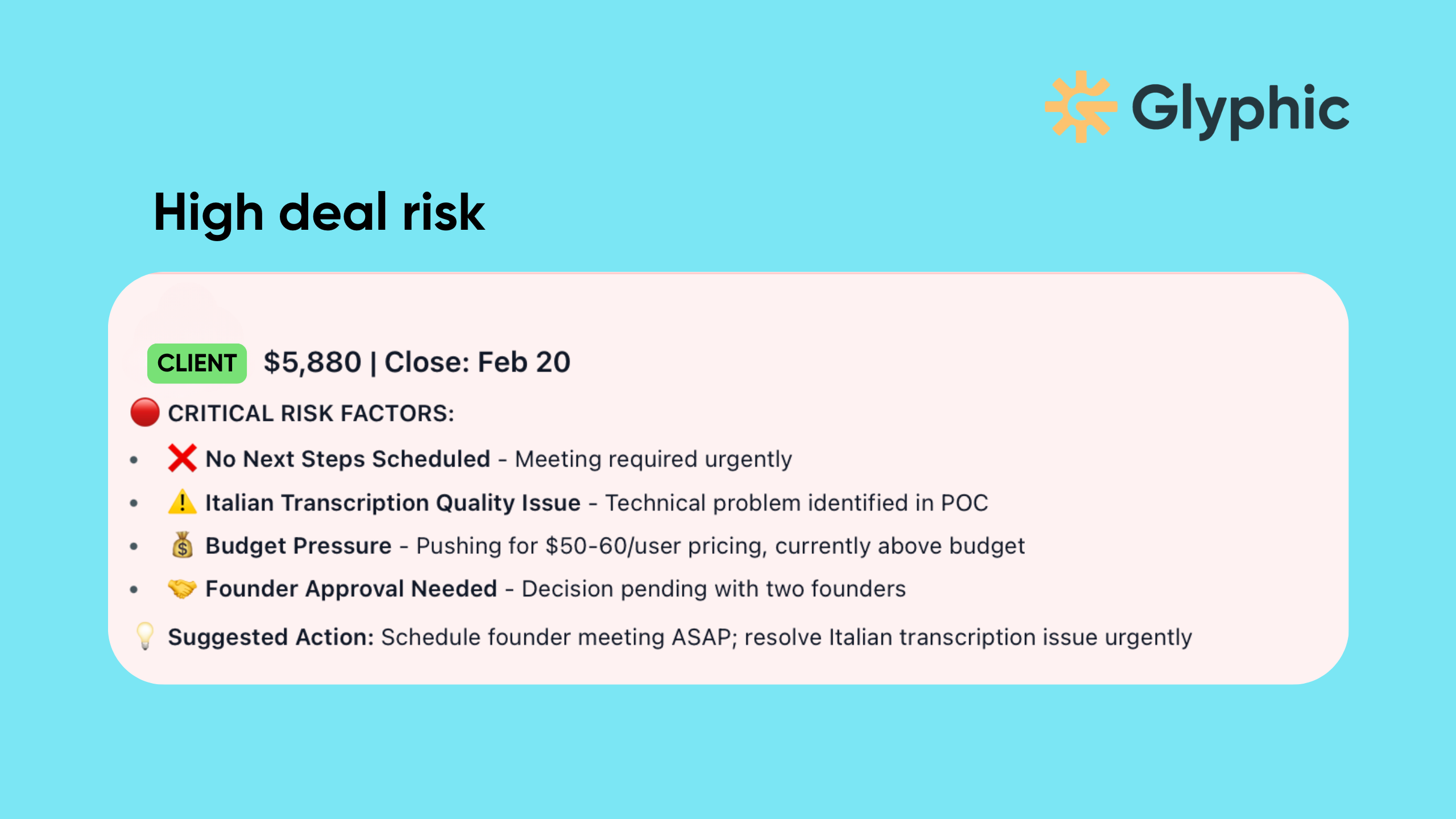
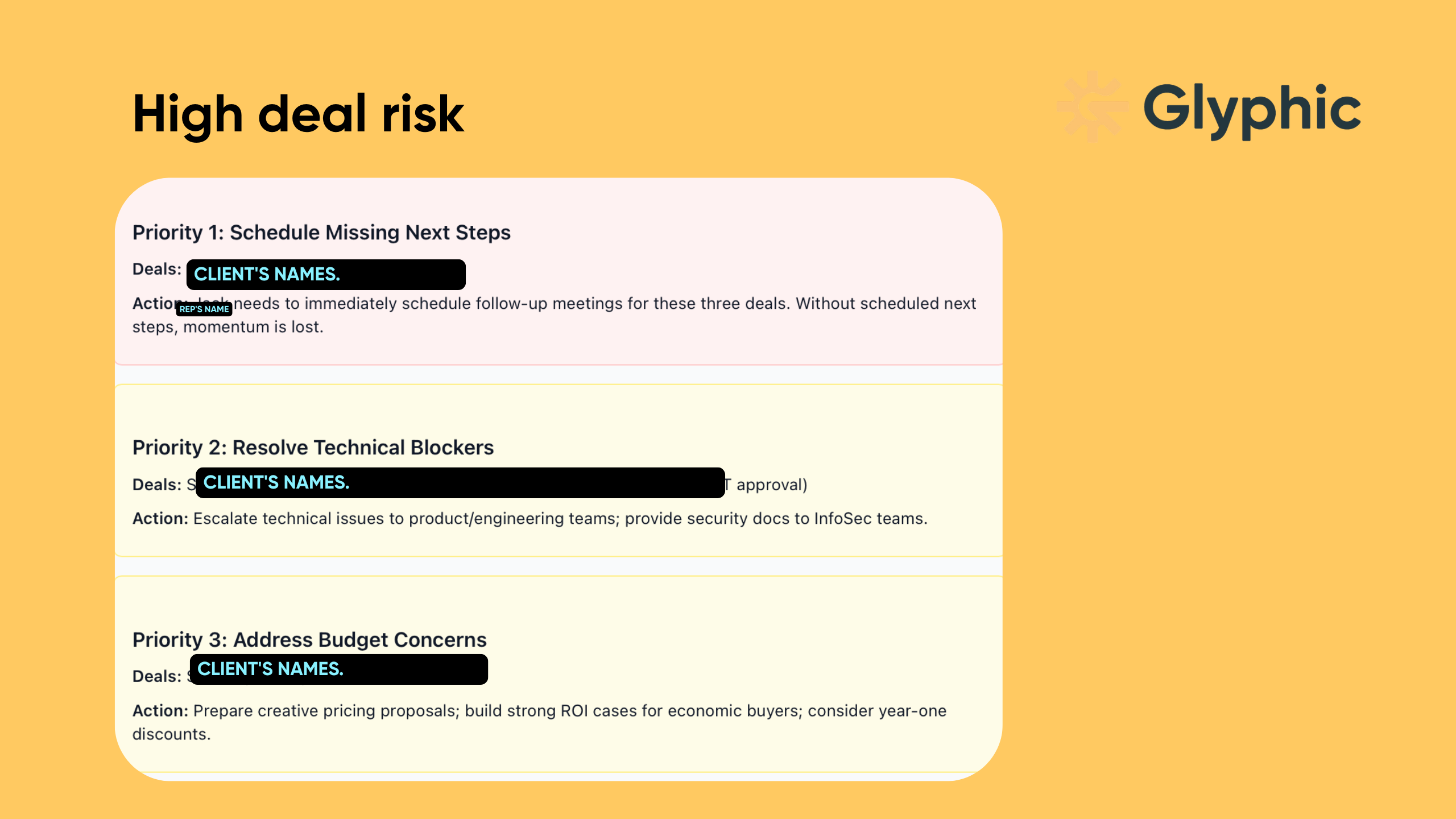
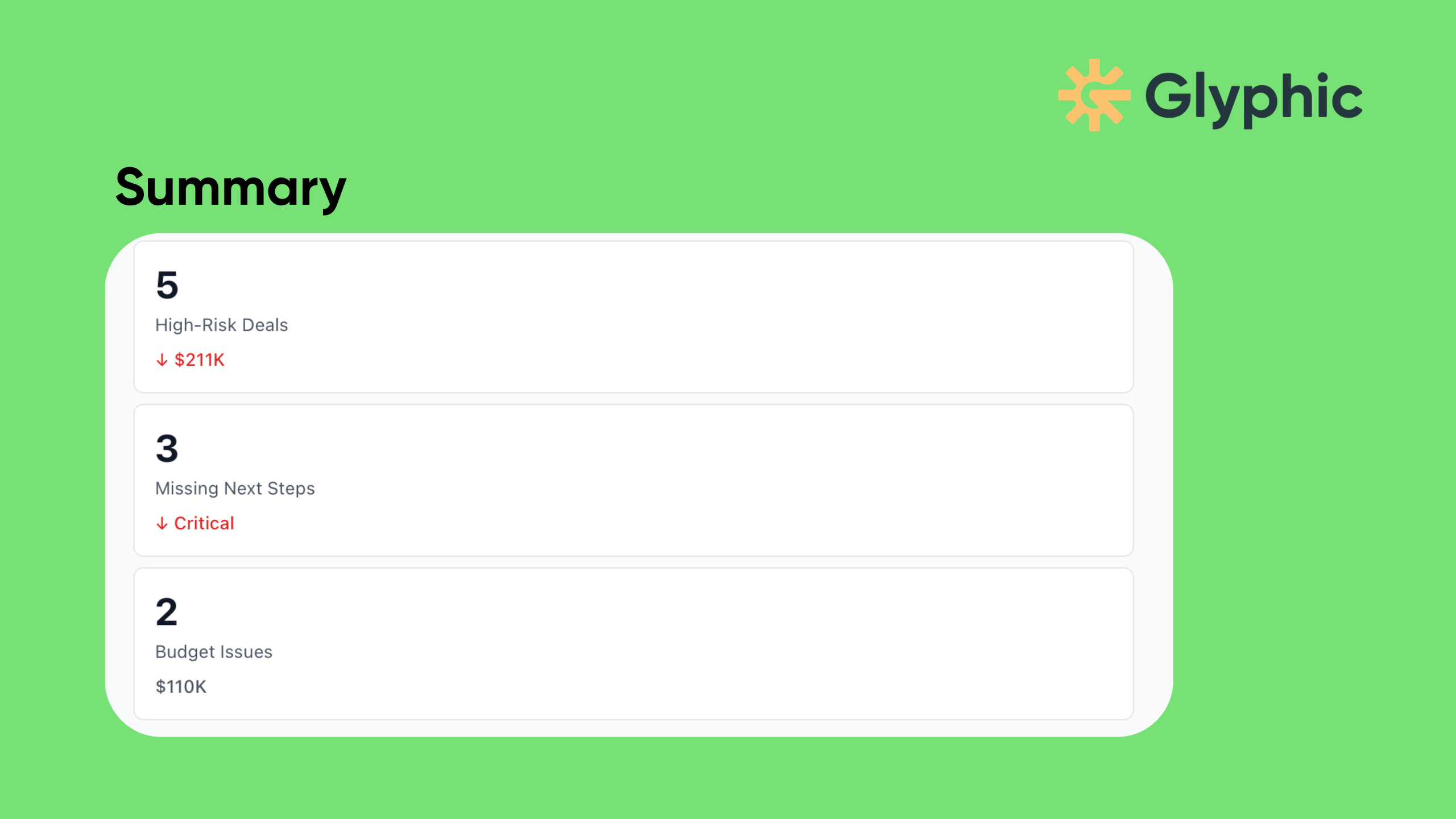
Every week it produces a prioritized list of which deals are most at risk, why, and what needs to happen to de-risk them.
He described it as "playing in God mode."
Instead of manually scanning 40 deals and guessing, his team focuses on qualifying out the 34–36 that won't close. Because the truth is: with 40 deals in pipeline, you might close 4 or 5. The best thing in sales is a yes. The second best thing is a fast no.
Teams that win consistently don't let things quietly stall for months. They proactively qualify out, close-lose deals that aren't real, and keep their pipelines clean.
The agent Mathew built doesn't ask reps to add more information — it forces more clarity on what's already there.
Here's a rundown:
The Bottom Line
Deals don't stall randomly. They stall predictably, and the signals are there if you know where to look. The teams that outperform aren't the ones with the most deals in pipeline — they're the ones who are most honest about which ones are real.
If you want to see how Glyphic can help your team do the same, get in touch.
10x your sales team with Glyphic
Supercharge your conversion rates and save up to 34% of your sales rep's time, by automating mundane tasks.


