
5 Revenue execution mistakes costing your team pipeline – and how to fix them
For years, sales leaders have blamed disappointing revenue performance on “rep execution” — the idea that individual sellers simply aren’t doing enough, not doing the right things, or not doing them consistently.
But if you dig into actual sales interactions and revenue workflows across modern organizations, a different picture emerges:
The biggest barriers to predictable revenue are not skill gaps — they are system design failures.
In dozens of sales call transcripts and deal discussions we’ve analyzed, the same themes keep showing up: broken workflows, fragmented tools, data distrust, and process gaps that silently kill deals before they ever hit the board.
Below, we unpack the five recurring execution failures and what sales and RevOps leaders are doing to fix them.
1. CRM trust crisis and data hygiene breakdown
Sales teams are vocal about their lack of trust in CRM data. Rather than embracing automation, they resist it by demanding manual control, fighting over messy fields, and avoiding data entry altogether.
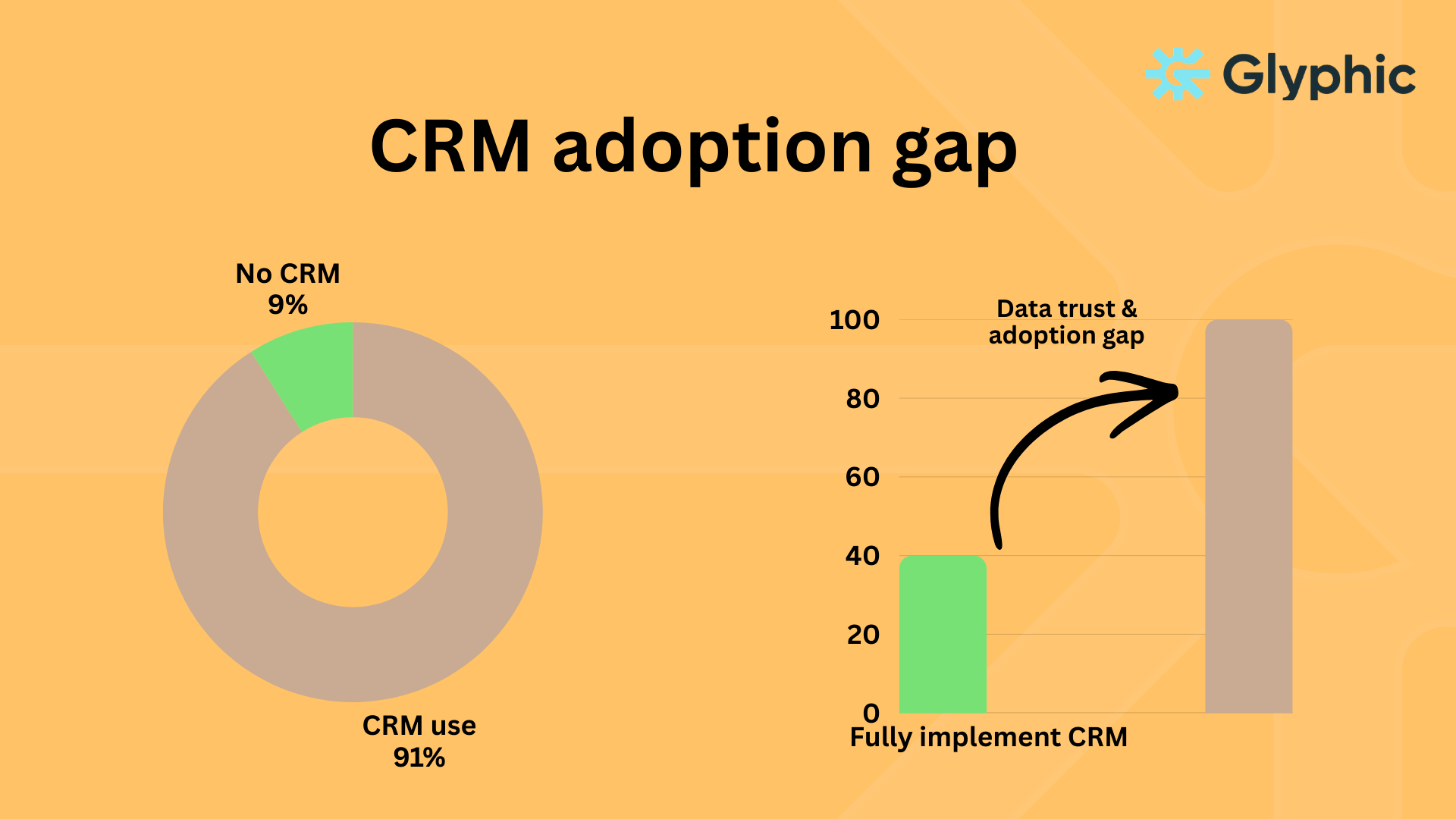
CRM adoption is nearly universal: roughly 91% of companies with 11+ employees use CRM platforms to manage customer interactions and sales activities. Yet less than 40% of organizations fully implement their CRM in a way that drives real adoption and reliable data flow. (CRM.org)
This gap between tool availability and tool trust leads to:
- Shadow systems (spreadsheets, Slack notes)
- Incomplete pipeline visibility
- Forecast inaccuracy
What we’ve learned
Teams debated manual override controls rather than improving core automation. Concerns about duplicated free-text fields and untrusted MEDDIC syncs are common — especially in deals above $50K, where rigorous qualification is expected.
This isn’t a people problem, it’s a data trust problem. Without confidence in what the system generates, reps default to control. Leaders must invest in trust architecture – explainable AI, confidence scoring, data provenance – not just accuracy.
⚡ How Glyphic helps: Glyphic automatically captures deal activity from calls, emails, and meetings, reducing manual CRM entry and surfacing data reps can actually trust - without the spreadsheet workarounds.
2. Forecasting process fragmentation and tool proliferation
Right now, most revenue teams aren’t forecasting in a single system. Managers use one tool, reps use another, and executives look at a third. Nobody agrees on pipeline reality. Tools like Salesforce, Clari, Gong, and various pipeline helpers all live side by side—each with its own data model and UX.
"We spend the first 20 minutes of every forecast call just reconciling numbers between Salesforce and Clari before we can have any real conversation," might sound familiar.
Research shows 70% of companies struggle to integrate their sales plays into CRM and revenue technologies, limiting growth potential. (Bain) This fragmentation creates:
- Misalignment between rep and manager forecasts
- Confusion about pipeline health
- Reactive deal management
What we’ve learned
Reps avoid clunky CRM interfaces and use alternatives like Scratch Pad. Managers edit forecasts manually in tools like Gong. Executives reconcile all of it ad hoc in meetings.
This means that forecasting is an execution architecture problem. If different stakeholders can’t agree on a single version of the truth, the system fails before deals close.
⚡ How Glyphic helps: Glyphic consolidates deal signals across your stack into one unified view - so reps, managers, and execs are aligned on the same pipeline reality, not three different versions of it.
3. Qualification framework theater: MEDDIC populated but not leveraged
Qualification frameworks (e.g., MEDDIC) are implemented but not operationalized. Fields are filled to satisfy compliance, not to guide decision-making.
"We have MEDDIC in Salesforce. But I still can't tell you which deals in my pipeline have a confirmed economic buyer without manually clicking into each one," is a common concern.
CRMs promise better pipeline clarity and forecast accuracy—organizations using CRM can see up to a 32% improvement in sales forecast accuracy when data quality is strong. (b2breviews.com)
But if qualification fields become checkboxes, the benefits disappear.
What we’ve learned
Managers want real insights (e.g., budget approvals, procurement status) in their deal views. They struggle to see which deals lack economic buyer engagement without manual digging.
The issue here is that systems don’t activate MEDDIC as a decision tool. Leaders need automated deal health scoring and real-time alerts that turn fields into signals.
⚡ How Glyphic helps: Glyphic turns your MEDDIC fields into live deal intelligence for your team - automatically flagging deals missing an economic buyer, stalled champion engagement, or absent procurement timelines, so you can act before it's too late.
4. Deal review preparation burden and context switching overhead
Managers spend hours prepping for deal reviews because relevant information lives in too many places: CRM, call recordings, emails, Slack, and spreadsheets.
"I block off two hours every Sunday to prep for Monday's pipeline review. That's two hours I'm not coaching, not thinking strategically, not doing anything useful," are typical complains.
Even firms that invest in multiple analytics and intelligence tools often fail to reduce manual work. A HubSpot survey found that 92% of companies acknowledge key data sits outside centralized systems, significantly hampering AI readiness and workflow clarity. (TechRadar)
What we’ve learned
Sales leaders repeatedly described painful manual consolidation ahead of pipeline meetings and 1-on-1s. Managers felt they didn’t have time to review all deal warnings or opportunity signals due to fractured information.
More dashboards aren’t the answer — data and team synthesis is. Leaders need systems that automatically surface what changed, highlight risk indicators, and present what matters.
⚡ How Glyphic helps: Glyphic auto-generates deal briefs before every pipeline review - summarizing what changed, what's at risk, and what action is needed, so managers can spend their time coaching instead of consolidating.
5. Multithreading and buying committee blindness
Deals are getting more complex, with larger buying committees and multiple stakeholders — yet systems still treat engagement tracking as an afterthought.
Fragmented engagement data leads to late-stage surprises. Winning enterprise deals today requires coverage across roles, functions, and priorities and most systems simply don’t make that visible.
What we’ve learned
Only a fraction of users had connected calendars and emails to centralized tools. Engagement matching algorithms were misassigning contacts, and teams lacked visibility into who was truly engaged.
Multithreading is not about rep skills but about visibility. Teams need relationship intelligence that automatically identifies coverage gaps and helps leaders prioritize engagement across the real buying group. Otherwise deals collapse when a single champion loses influence.
⚡ How Glyphic helps: Glyphic auto-generates deal briefs before every pipeline review — summarizing what changed, what's at risk, and what action is needed, so managers can spend their time coaching instead of consolidating.
The real problem? It is not your reps, it’s your revenue execution architecture
Across every pattern above, the root isn’t inconsistent reps. It’s systems that make disciplined execution harder than it should be.
Sales and revenue execution are no longer human-scale problems alone, they are cross-tool orchestration problems requiring:
- Better data integration
- Trustable automation
- Unified forecasting planes
- Active decision support
- Relationship visibility
- Intelligent deal synthesis
And yes, rep performance matters — but they can only shine when the underlying systems actually work.
For decades, revenue leaders have asked:
“How do we coach better?”
“How do we drive rep accountability?”
The right question now is:
“How do we build systems that make execution consistent, reliable, and predictable?”
Because until you do that, no amount of coaching, best practices, or playbooks will move the needle at scale.
See how Glyphic helps you fix these problems → Book a demo at glyphic.ai
10x your sales team with Glyphic
Supercharge your conversion rates and save up to 34% of your sales rep's time, by automating mundane tasks.


